
The university is further expanding its learning space portfolio for the start of the 2026 summer semester: The ongoing implementation of modern learning architectures and self-study areas in the new building will create new opportunities for studying and teaching.
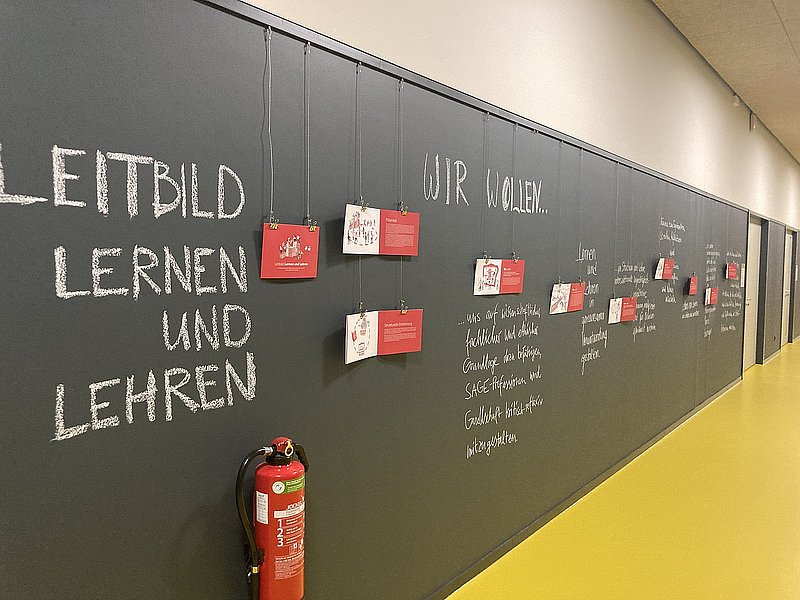
Teachers and students are invited to actively integrate the new learning architectures into their teaching and learning processes. It is about more than new spaces: it is about new forms of learning. The close integration of architecture and didactics opens up specific opportunities for collaboration as well as individual and self-directed learning and takes into account the heterogeneity of learning styles and working methods. In this way, the change towards a student-centered, competence-oriented and inclusive teaching and learning culture in the sense of the Learning and teaching mission statement is supported.
The focus is on innovative and agile learning environments that promote project-oriented work, enable the development of future skills and digital competencies and strengthen collaborative learning processes. The result is a networked campus where formal and informal, analog and digital teaching/learning formats are flexibly intertwined - and new spaces for exchange, community and social interaction are created.
Official opening of selected special rooms
The opening of two selected special rooms on Monday, May 11, 2026 offered a very special insight into the new possibilities. Over coffee and tea, the rooms could be explored, tried out and needs discussed together.
The following two spaces, which exemplify the new concepts, were officially opened:
- The Future Skills Work Space is designed by the Service Center for Writing and Study Skills and the team for international newcomers and is aimed at students with extracurricular offerings. Here, skills such as academic work, digital skills - for example in dealing with AI - and collaboration are specifically promoted.
- The media didactics room is supervised by the Digital Media Didactics department and supports lecturers in developing courses that promote learning through the use of media. In addition to user-friendlysettings for video recordings, AI and VR applications as well as a podcast studio with several speaker stations arealso available.
Flexible, versatile, activating
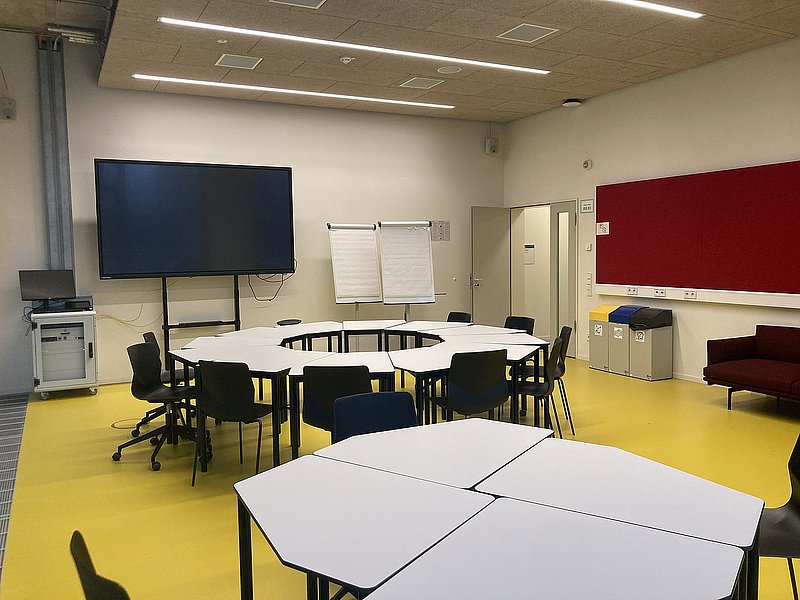
The new learning spaces are consistently designed for flexibility and open up a wide range of didactic possibilities. The rooms are equipped with flexible seating furniture such as rollable, height-adjustable swivel chairs and lightweight four-legged chairs, as well as a health-promoting sit-stand stool in combination with a height-adjustable desk for the teaching staff. This enables ergonomic, dynamic and flexible seating that meets the individual needs of students and teachers. At the same time, the different seating options support different learning postures and working methods - from concentrated individual work to dynamic group processes - and promote attention, participation and well-being, even during longer learning phases.
The rooms are equipped with a variety of furnishing elements and technical equipment, including the innovative pentagonal tables, which offer numerous flexible combination options for different teaching/learning settings. They encourage collaborative working as they can be quickly arranged into group islands, circles or open work landscapes. Different social forms such as plenary sessions, small groups or individual work can be implemented without wasting time and support varied, activating teaching. This creates communicative settings at eye level that support activating methods such as discussions, group puzzles or design thinking formats.
The rooms expressly invite active participation: Teachers and students can adapt settings according to the situation and thus respond optimally to their teaching and learning scenarios. In order to maintain this flexibility, the university community is asked to use the rooms responsibly and to return them to their original state after events. Diagrams of the facilities can be found in the rooms and in the LSF.
Modern technology for networked teaching
The rooms also offer a wide range of technical possibilities: Large interactive displays, easily accessible media technology and the uncomplicated integration of personal devices enable collaborative work and spontaneous visualizations in addition to presentations. In some rooms, additional monitors ensure better visibility and enhanced opportunities for digital collaboration.
In the future, selected rooms will be equipped for hybrid teaching - with cameras, ceiling screens and room microphones. This will enable courses to take place both on site and online at the same time and new forms of collaboration, for example with external experts, can be realized.
Inclusive and accessible
Special attention is paid to barrier-free learning environments. Microphones and loudspeakers are available as standard to improve acoustics, while induction and infrared hearing systems make it easier for people with hearing impairments to participate. Large displays provide higher-contrast, brighter and sharper images than the projectors predominantly used to date and are also easy to see in daylight. The flexible furnishing of the rooms allows them to be used according to individual needs and creates space for movement, e.g. for wheelchair users. In this way, the learning spaces make an important contribution to inclusive teaching and equal participation.
More space for exchange: community hub and self-study areas
In addition to the seminar rooms, other places for learning and meeting are being created: a community hub is being set up and expanded on the first floor, which will offer space for transfer and community-oriented formats in the future and will be gradually developed further. The first events can take place there as early as the summer semester if required.
The offer will be supplemented by numerous self-study areas throughout the building. Different zones for quiet and communicative work, flexible furnishings and additional common areas create space for independent learning, exchange and short breaks between courses.
Co-design and develop further
The new learning architectures will be evaluated over the course of the semester. Teachers and students are invited to participate and contribute their experiences via QR codes in the rooms. In this way, the courses can be further developed in line with demand.
In addition, an accompanying didactic program for lecturers offers opportunities to explore, test and exchange ideas with colleagues about the didactic potential of the new rooms. This university didactic support program is supported by the following departments University Didactics and Innovation, Digital accessibility in studying and teaching and Digital Media Didactics of the QME SuL department.
Some of the offers in this accompanying program are explicitly aimed at all interested parties, i.e. students, staff and lecturers, in order to co-creatively shape the further development and appropriation of the learning architectures together.
Conclusion: The extension not only creates new spaces, but also opens up new opportunities for teaching and learning as well as for collaborative working - flexible, inclusive, collaborative and future-oriented.