

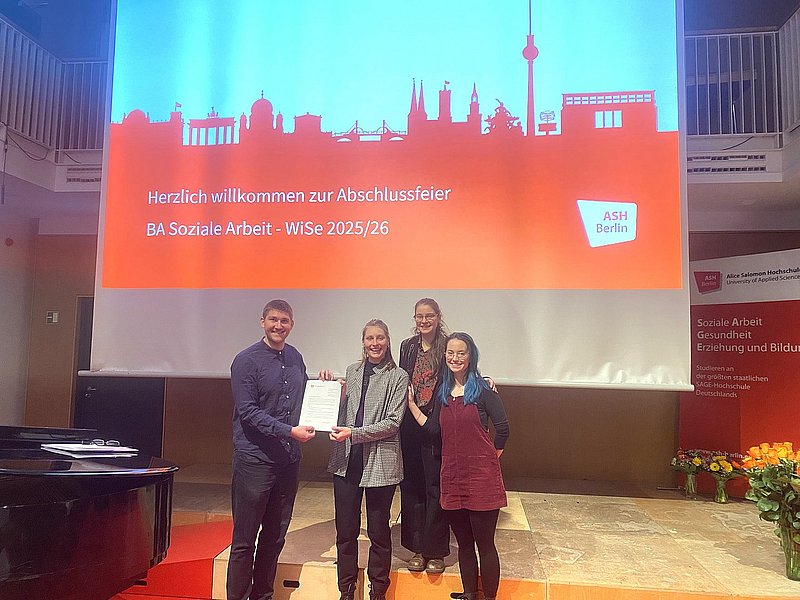
The Sustainability Certificate has been awarded by the Sustainability and Health Department at ASH Berlin since the summer semester 2025. It originated from the climate and sustainability requirements placed on ASH Berlin. In the climate protection agreement for the years 2023 to 2032 and in the sustainability clause of the Berlin university contracts 2024-2028, the field of action 'Studies, teaching, research and transfer' can be found in each case. In the climate protection agreement, ASH Berlin commits to "anchoring sustainability and climate justice as a cross-cutting issue in studies, teaching and transfer" (Annex 2, page 2).
Commitment recognized
The sustainability certificate comprises three criteria. Students must earn at least ten credit points in courses with a sustainability focus. In addition, they must have been involved in the student sustainability initiative TrASHform for at least three semesters. As a third criterion, the final thesis must be written with a sustainability focus or an internship in this field must be completed.
Vanessa Kron, Michelle Liebheit, Svenja Teschner and Mia Washofer formed the core team of TrASHform for six semesters. They were regularly involved in the orientation days, organized clothing swaps at ASH Berlin, networked with the sustainability initiatives of other Berlin universities, carried out waste separation campaigns and helped with data collection for the climate justice concept. Together, they were also active in a project seminar on Education for Sustainable Development (ESD) in the Social Work degree program. In their Bachelor's theses, they focused on the connection between social work and sustainability - with different specifications on transformative education, community organizing, animal rights education or nature experiences.
Multipliers for the future
The sustainability certificate is intended as recognition for their achievements and commitment. At the same time, it is hoped that they will be able to act as sustainability multipliers in their future professional lives. Welfare organizations in Germany have set themselves climate and sustainability goals. The German Caritas Association, for example, wants to be climate-neutral by 2030. In order to achieve this, specialists are needed who have the necessary expertise and appropriate strategies for action.
Further information on the sustainability certificate can be found on the ASH Berlin sustainability website.
