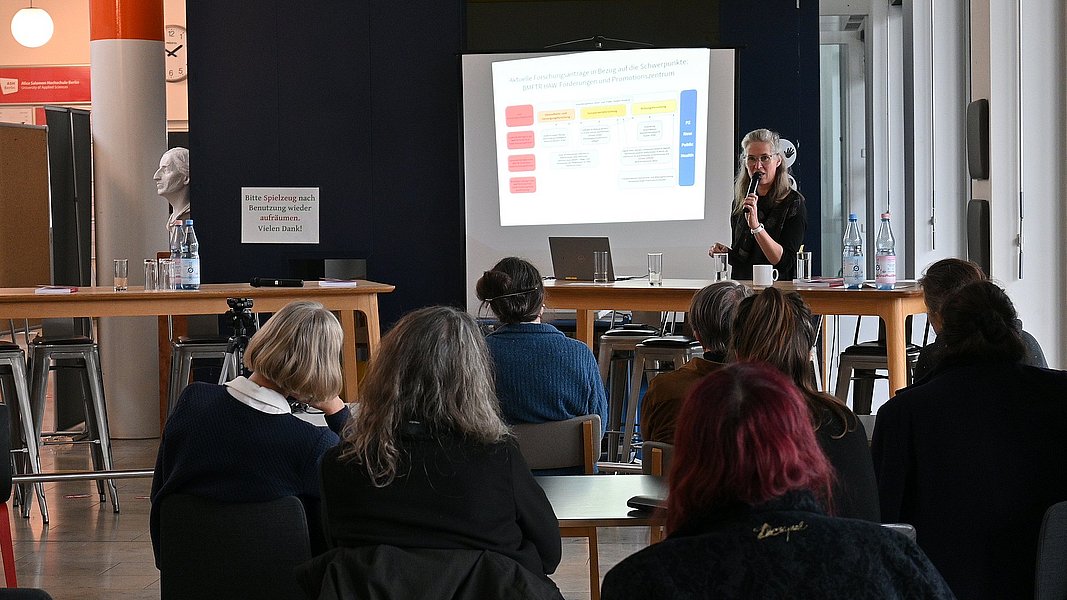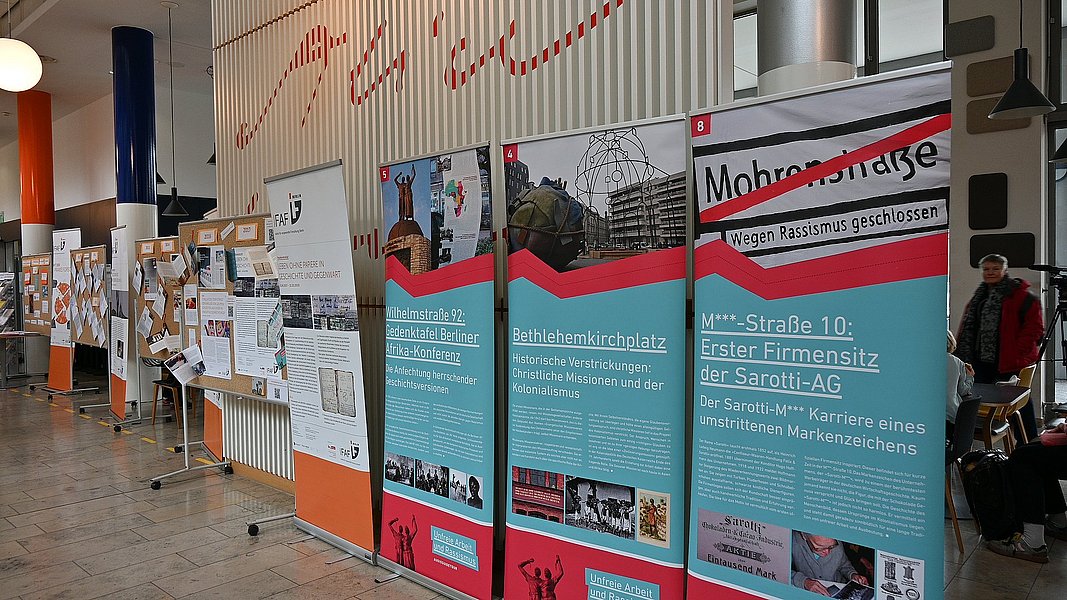

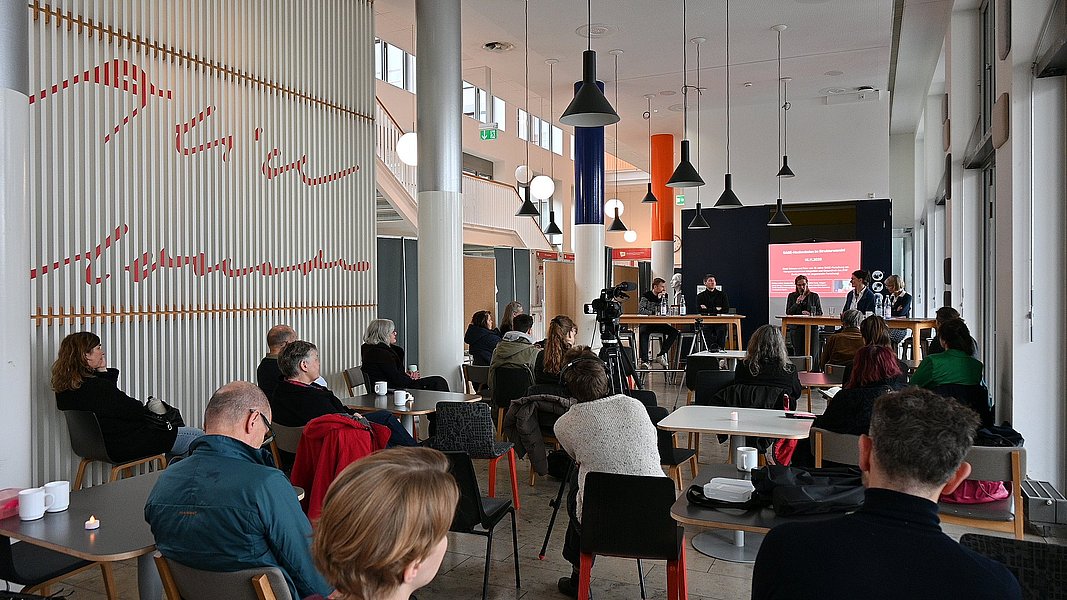
On November 18, 2025, Alice Salomon Hochschule Berlin (ASH Berlin) hosted a special event in the foyer of the university. Under the title "SAGE universities in structural change", two important milestones in SAGE development at ASH Berlin were honored: the publication of a new scientific anthology and a review of 16 years of research activities by the IFAF Competence Center Integration and Health.
Publication of the anthology: "Academize, professionalize, transform"
With the presentation of the new anthology "akademisieren, professionalisieren, transformieren. SAGE-Hochschulen im Strukturwandel am Beispiel Alice Salomon Hochschule Berlin", published by Barbara Budrich Verlag, the university presented a central result of the Sage SAGE! project. The project is funded by the Federal Ministry of Research, Technology and Space and the State of Berlin. The acronym "Sage SAGE!" means: "Establishing system-relevant academization in a gender and diversity-friendly way in the subjects of social work, health and nursing, education and training!"
The volume sheds light on the SAGE profile of ASH Berlin and addresses, among other things, the tasks and struggles of academizing the nursing and therapy professions, the human rights orientation of ASH Berlin, forms of workshop work to reflect on professional practice and interdisciplinary cooperation in the SAGE field. The anthology is available both in print and - thanks to third-party funding - digitally via Open Access. Library director Joachim Dinter praised the open access publication in light of the fact that the majority of journal publications from the academic Berlin area are now publicly available.
At the beginning of the event, ASH President Prof. Dr. Bettina Völter welcomed the editors and guests in attendance. Among them was Laura Neugebauer, member of the Berlin House of Representatives and science policy spokesperson for the Green Party parliamentary group. Dr. Philipp Kenel, Dr. Yannick Liedholz, Prof. Dr. Bettina Völter, Prof. Dr. Anja Voss and Prof. Dr. Elke Kraus discussed the central contents of the book on the podium.
Völter explained the difference between the SAGE portfolio (i.e. the range of subjects offered by the university) and the SAGE profile (i.e. the special features of the SAGE subjects, the resulting tasks, expertise and added value). In her contribution, she drew a bow to the further development of ASH Berlin as part of the process of structural development of the entire Berlin higher education system.
Elke Kraus presented the contribution to the primary qualifying Bachelor's degree course in physiotherapy/occupational therapy , which was written jointly with Dean Prof. Dr. Michael Erhart and his team. She emphasized the urgency of academizing these professions, in which Germany continues to lag behind in Europe and worldwide with its training opportunities. With a view to the end of the model clause and the forthcoming amendment of professional laws, Kraus pointed out the risks of dual career paths and the threat of duplicate structures.
In his contribution, Yannick Liedholz argued for a comprehensive opening of all degree courses to the topic of sustainability. Philipp Kenel introduced a critical perspective with reference to the importance of economic issues and warned against an overly narrow understanding of the concept of SAGE.
Finally, Vice President Anja Voss gave an outlook on her contribution planned for the second edition with Prof. Dr. Claudia Hruška, which is dedicated to childhood education.
Review of 16 years of research at IFAF Berlin
In the second part of the event, Vice President Prof. Dr. Gesine Bär looked back on 16 years of SAGE research at IFAF Berlin. Since its foundation, the Institute for Applied Research Berlin (IFAF) has networked the four state universities of applied sciences in Berlin and strengthened the transfer of knowledge and technology through research collaborations with regional partners.
The IFAF Berlin Competence Center for Integration and Health, which is based at ASH Berlin, has made a significant contribution to raising the profile of ASH Berlin during this time. Bär presented two examples of the 53 projects carried out in recent years and emphasized the high practical relevance of the funded research: the results directly benefit the state of Berlin. At the same time, she explained the upcoming structural realignment of IFAF: in future, the institute is to act as an umbrella brand for Berlin's universities of applied sciences, with the prospect of expanding to include the city's two denominational universities.
Prof. Dr. Corinna Schmude and Prof. Dr. Olaf Neumann then presented projects that they were able to realize with the support of IFAF Berlin. Both emphasized the practical benefits of their research projects and the importance of funding for application-oriented science at ASH Berlin.
Bär concluded by referring to IFAF Berlin's annual budget of two million euros, which has been "adequate" over the years. The institute has achieved a great impact with comparatively little funding - which makes it all the more regrettable that there is currently a lack of political support.
Outlook
The event marks an important step in the preparation of ASH Berlin for the process of structural development of the Berlin university system. The look at the research profile and the publication of the new anthology underline the importance of the university's SAGE profile, also in the area of system-relevant research and transfer - and at the same time provide impetus for the future orientation of a practice-oriented, interdisciplinary and socially committed university.