

How can the practice of mindfulness and self-care, teaching approaches and method development, value-conscious relationship building and a responsible approach to the common good, democracy and nature be taught in higher education?
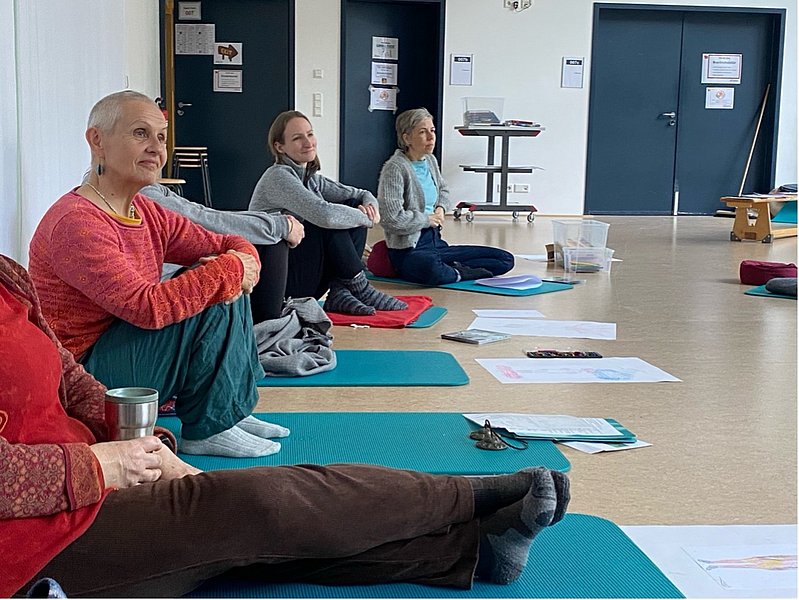
Questions like these were addressed by a total of 22 educational stakeholders at the 12th nationwide workshop conference "Mindfulness at Universities" at the Alice Salomon University of Applied Sciences Berlin on March 6 and 7, 2026. The conference has been organized and hosted at ASH Berlin since 2012, this time by Nils Altner, Claudia Hruška and Bettina Völter. The workshop conference makes a difference by offering opportunities for exchange for all participants in an open format: Impulses and short lectures alternate with meditation and other forms of practice, with the testing of methods, seminar design offers and concepts as well as with information about new approaches. Especially in stressful times such as these, in which many conflicts, wars and threats to democratic forms of behavior are very close at hand, pausing, visualizing, networking and gathering strength is an essential aspect of mental survival and protection against overload. In a society in which the consequences of structural cuts to social, educational and healthcare provision are increasing and pressure is being exerted to restrict the achievements of equality, diversity and solidarity, the practice of meditation, sensory perception, listening and connecting encourages the courage to take a political and practical stance and stand up for democratic values and human rights.
In the areas of higher education, we face numerous challenges, such as: accompanying students well and at the same time supporting them in active action, encouraging them to open up to beauty and a connection to nature, to others and to themselves, providing frameworks in which strength and hope for fundamental change can be drawn.
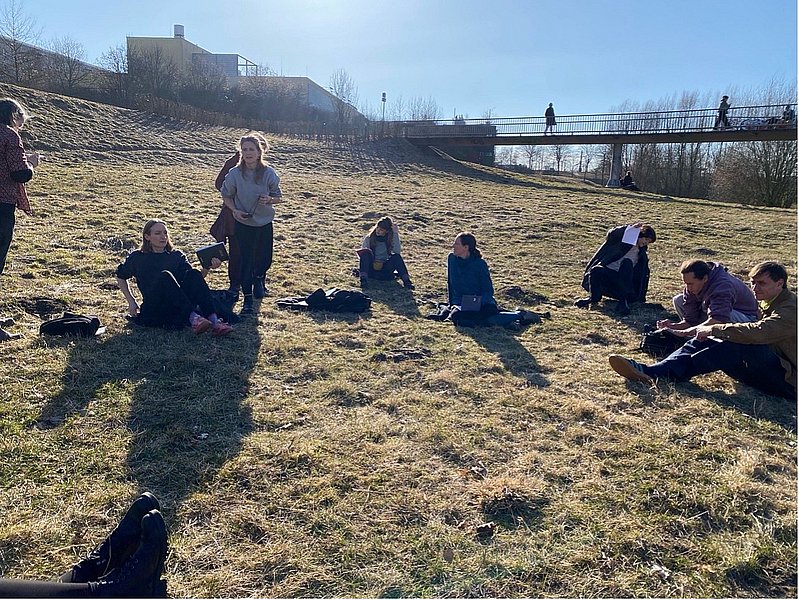
At this year's workshop conference, the contributions ranged from conflict resolution and empowering methods in teams, shared outdoor experiences close to nature with Cornelia Wiek and Elisabeth Blanke (Leipzig University), scenic performative play on the meadow at Hellersdorfer Graben, aesthetic-art-based approaches to in-depth exploration of inner processes with Martina Janßen (BTU Senftenberg) to the practice of guided R-A-I-N meditation according to Brach (2020) with Bettina Völter (ASH Berlin). Further topics of these contemplative forms of embodiment-aesthetic cultural education were art-based self-reflection with Helga Luger-Schreiner (KunstUni Linz & AANAA), the Social Presencing Theater with Inga Beek (ASH), speaking and listening with Frauke Godat (Uni Kiel), The Work with Sanja Böhler-Koddenbrock (Schulaufsicht Euskirchen), working with inner parts of the personality with Nele Neuhäuser (Klinik f. Psychotherapie Eberswalde), Claudia Hruška & Nils Altner (ASH Berlin), the Social Action Approach with Andreas Richter (KHSB), poetry and silence with Susanne Klimroth (HU Berlin) and methods of interaction research in early education with Juliane Lehmann (University of Leipzig).
The different methodological approaches were offered and experienced by the participants in a co-creative way; they led to a pause and re-sorting as well as a focus on the essential aspects of one's own work. This gave rise to new ideas for working with students. The weekend also offered options for finding ways out of stagnant processes or powerlessness to connect with oneself and others in order to be able to continue or resume acting prudently and professionally.
What is special about this conference format is the experience of methodical approaches to higher education that go beyond purely cognitive processes. Consciously looking, listening, moving, feeling the sun and the wind on your skin and the sensory, trusting exchange of experiences created space for a mindful and close cooperation. Again and again, moments of shared silence opened up spaces for encounters with one's own physical presence and body-conscious togetherness.
In this respect, mindfulness approaches not only lead to a self-strengthening and health-preserving approach to oneself, but also enable connection with others and professional action in challenging situations as well as the development of a positive team culture. As a result, an opening, broader spectrum of action can once again enable people to become more flexible and react to external and internal demands in an adequate and consciously creative way.
We would like to thank all participants for the inspiring and cordial cooperation and invite you to the next workshop conference at ASH Berlin on March 5 and 6, 2027, which will focus on collegial intervision in mindfulness-based university teaching and research.
References
Brach, T. (2020). Your Fearless Heart: Healing Difficult Emotions with the RAIN Method (J. Elze, transl.; German first edition). O.W. Barth.