

On February 26 and 27, 2026, the conference "Exploring literary worlds - a walk through university learning workshops in Berlin" took place. Insights into other worlds, into the worlds of other workshops, an introspection and a presentation of ideas, concepts and methods. Full of curiosity and expectations, we ventured this four-part experiment to show our workshop work, to outline the workshops, their structure and their methods.
The international association "Netzwerk der Hochschullernwerkstätten e.V." (NeHle) was founded in Bremen in 2017 and offered decentralized, smaller conferences and exchange rounds this year. University learning workshops offer practical impulses for the study of pedagogical orientations and, in addition, concepts for education, training and further education, especially for educators in all areas from elementary to adult education, are (further) developed. Through the exchange between the designers of the university learning workshops, we can jointly agree on the theoretical and conceptual justification of the design of the premises, structural and material challenges. In addition, university learning workshops serve as test rooms for the transfer into practice and for processes of reflection on didactic-methodological impulses as well as for practice-oriented research.
On the first day we started at the FU and a formerly used seminar room was given a new lease of life. As a "Literary Education Learning and Research Space" in the Silberlaube around Lis Schüler, Franziska Herrmann, Anna-Lena Demi, Fritz Kempas and others. This well-structured workshop offers not only picture books from a wide range of categories but also work on the inner engagement with the specific books on individual shelf levels. They form their own worlds, which have been artistically designed. The team provided didactic insights into the methodological and didactic work, combined with digital elements and the creation of small self-produced videos, which gave rise to discussion, negotiation, description and design in small groups. The detailed phenomenological descriptions of the vignettes from teaching situations or didactic experiments in the workshop also provided ample opportunity for a linguistically reflective examination of the texts. Reflecting on the levels of interpretation and views of student work offered a variety of discussions and also the big question: how can these impulses from the course really be transferred into practice?
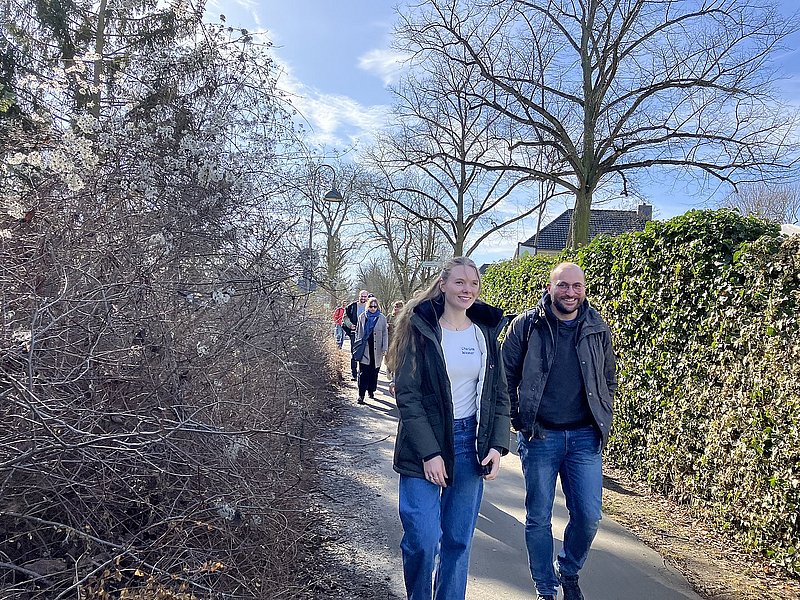
A walk offered the opportunity for further exchange and led us to the Domäne and a lunch and then across the agricultural land to the Podbielskiallee subway station and on to the UdK. Here we were able to slow down completely and immerse ourselves in the world of Kirsten Winderlich's picture book workshop. In collaboration with Olaf Eliasson, a space for education and images was created that invites us to linger, dream, move and let ourselves be moved. We lay down, reclined and browsed, came to rest, some fell asleep briefly, in short, we all became very quiet, even the noise of the nearby street hardly disturbed us. We exchanged conceptual thoughts about the space as an educational landscape, the struggle for spaces and design options - stimulating, aesthetic, inviting. Inspired by the concepts of the Grundschule der Künste and the successful aesthetics and presentation of the activating works on the in-depth examination of contemporary picture books, picture book art - picture pictures created by Kirsten Winderlich, Conrad Rodenburg, Sophia Ashraf and Helen Naujoks. At the end of the day, we enjoyed a delicious meal prepared by the UdK team at a lovingly designed table.
On Friday, we immersed ourselves in the world of Alice Salomon University, albeit hampered by the Berlin transport strike. Around my team - Irina Höfker, Vitaliy Persydskyy, and Clara Puschadel and the children's book literacy showcase by Dagmar Bergs-Winkels. We showed that the childhood education courses have already created four university learning workshops, with mathematics and communication and language combined in one space. We started with a focusing mindfulness exercise and awareness of the oral cavity. It carried us on to the mindfulness-based teaching-learning method of dyads. In a dyad, close listening is deepened as well as the uninterrupted expression of one's own experience on memories of one's own reading and literary habits and preferences.
In addition, a dyad offers the possibility of tracking on a mental, emotional and body-sensory level. It offered an invitation to show, hold and deepen encounters in today's fast-paced world. We changed rooms to the learning workshop, tested and discussed other forms of more therapeutic-oriented phenomenological case vignettes, e.g. to introduce students and practicing educators to the diversity of children with selective mutism or the use of supportive communication or exploration and reflection using eye-tracking glasses. We concluded with a didactic impulse on dialogic reading in large, small groups and 1:1 connections, shared our experiences and reflections and rounded off this visit with a mindfulness exercise and reflection round.
Scattered by various means of transportation, including bicycles, cabs and our own cars, we hurried into the city centre to the canteen of the Staatsbibliothek Unter den Linden. It was hot, almost early summer, and yet we sat together in the courtyard of the venerable State Library for a lunchtime exchange. The walk continued and ended in the university learning workshop in the primary classroom at Geschwister-Scholl-Straße 7 of Humboldt University, where Petra Anders was the host. She introduced us to the work with memes and VR glasses, which gave us completely different insights into the experiential space of today's children and new didactic possibilities. We tested our ideas in small teams and this revealed an advantage of the younger people - the images and references, such as sounds, are interpreted differently as they draw on other cinematic and other sources. Viewing and interpretation habits of different generations can connect and create opportunities for active cooperation.
Richly enriched by the diverse impressions of the four locations in Berlin, we want to continue working on our shared experiences, visit each other and create suggestions for transferring them to the educational landscape. This should further support us in our work to create shared thinking spaces and stimulating learning and educational landscapes both internally and externally.