

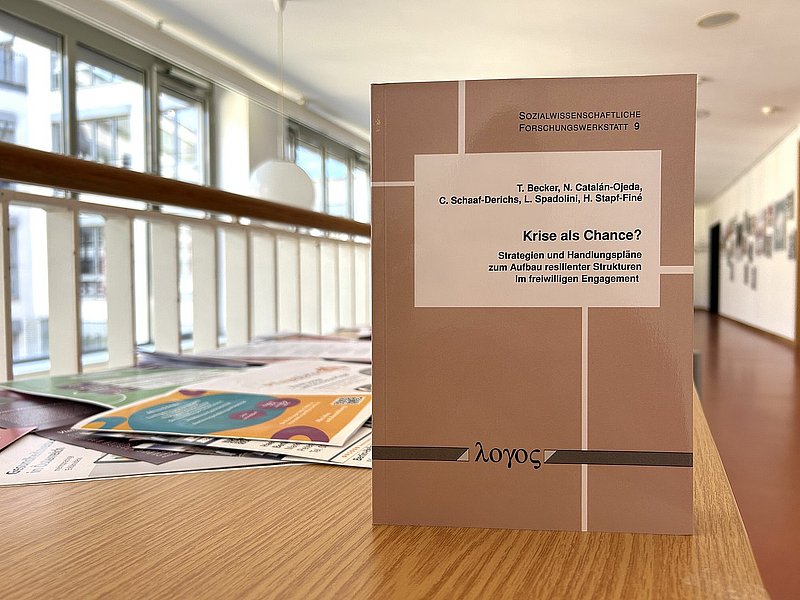
Prof. Dr. Bettina Völter, Professor of Theories and Methods of Social Work and President of ASH Berlin, spoke with Prof. Dr. Heinz Stapf-Finé, Professor of Social Policy at ASH Berlin and Director of the European Institute for Social and Health Research, about his new book "Krise als Chance? Strategies and action plans for building resilient structures in volunteering":
Prof. Dr. Bettina Völter: Dear Heinz, have you ever been involved in volunteering yourself?
Prof. Dr. Heinz Stapf-Finé: In my youth, I was active in the Youth Red Cross as an ambulance assistant. During my studies, I was a student representative in the academic self-administration. I joined the trade union during a vacation job and am still a member of ver.di. I was politically active in the SPD for a while and have been a member of the Workers' Welfare Association for a long time.
That sounds like a lot of personal experience. What have you learned over the years?
That it can be very stressful and that there are often situations in which there are tasks and offices to be distributed where it is difficult to find volunteers. In such situations, I have already taken on the responsibility and the task. But I have also found that there is something about this commitment that keeps you going: the feeling of being needed and being able to change something in society, perhaps even improve it.
As head of the European Institute for Social and Health Research at ASH Berlin, you have researched strategies and action plans in relation to volunteering in collaboration with colleagues and in cooperation with the State Volunteer Agency. The title of your book: "Crisis as an opportunity?" arouses curiosity and gives hope in view of ongoing crises such as the coronavirus pandemic, global wars, the energy crisis and the threat to our democracies - but could it also be read as a neoliberal relativization? In the sense of: Volunteering is suffering particularly in all the crises mentioned, but should it now pull itself out of the mire with even better strategies?
Hope is the leitmotif. The basic idea at the beginning of the project "Crisis as an opportunity? Strategies and action plans to reduce pandemic-related problems in access to volunteering" was: We - the European Institute for Social and Health Research, an affiliated institute of ASH Berlin - wanted to find out how the corona pandemic has affected volunteers and volunteer management in the areas of flight and migration and homelessness. We wanted to draw lessons from our experiences on how volunteering can be made more resilient and crisis-proof. When we received the funding commitment from the Lotto Foundation Berlin for the period October 2023 to September 2025, the issue became even more pressing. Other crisis-related developments such as the war of aggression in Ukraine, the resulting refugee movement, the energy crisis associated with the sanctions against Russia and the resulting inflationary pressure and, finally, the increasing threat to democracy posed by the shift to the right were added to this. And the present also shows that the era of multiple and permanent crises continues. This makes it all the more important to strengthen the many volunteers, not as a substitute, but as a valuable addition to state and professional action.
Back to the coronavirus pandemic: During the pandemic, a cross-disciplinary association of academics from ASH Berlin drew attention to the intensification of exclusions, social problems, discriminatory structures and other issues in organizations and fields of action in the social, health and education sectors (see, among others, Voss, Anja et al. (2020): Covid-19 as a burning glass on precarious conditions An interjection by SAGE researchers. In: alice Magazine, pp. 19-21; Kasberg, Azize (2021): SAGE sciences in social responsibility in and after the pandemic. In: Völter, Bettina et al. 2021): Völter, Bettina et al. (eds.): #systemrelevant. 50 years of applied SAGE sciences at the Alice Salomon University of Applied Sciences Berlin. Social Work SPEZIAL - Series on Theory and Practice. Berlin: self-published by DZI 2021, pp. 35-41). Has the situation eased - or are the warnings of 2020 and 2021 still valid?
Unfortunately, there is still no easing in sight, mainly because the social gap is still widening, the integration problems have not been solved and educational success continues to depend on the social situation. This makes it all the more important that the target groups of volunteering are no longer seen as mere objects of volunteering. Our research has shown how important it is to offer refugees or people who have experienced homelessness opportunities to volunteer themselves. This is important for their own self-development on the one hand and for social integration on the other.
And it also has a social dimension; their commitment is a valuable contribution to society. What importance do you attach to volunteering in our society?
Society would not function without volunteering. There is traditional volunteering, without which club boards, political parties or sports clubs would not function. The voluntary commitment of many people that supports professional work, particularly in the social sector, especially in fields where the work takes up a lot of time or is not adequately funded, such as telephone counseling or reading mentors in daycare centers. And finally, there are many overlaps with civic engagement, which often arises in the political arena in the interests of the target groups for which one is committed. In this respect, these forms of engagement are indispensable for social cohesion and the functioning of democracy.
What was your core concern when writing the book?
In addition to the aspect of strengthening voluntary engagement, the observation that there has been a professionalization in the management of voluntary activities was a guiding principle. Over the last 20 years or so, two main areas of activity have emerged. Strategic volunteer management, which is carried out at the management level of social organizations and is responsible for ensuring that the necessary resources are provided. And volunteer coordination, which is responsible for supporting volunteers. We wanted to explore this in more detail and contribute to more professional action in this area. Even though it must be acknowledged that spontaneous commitment is important and valuable, especially in crisis situations. But it often needs to be managed after a while so that it doesn't fizzle out again.
I can imagine that a lot of (implicit) experiential knowledge is created in all of this, which is not readily available, processed and fed back into the organizations. On what levels did the chosen methodological approach, the civic science approach, lead to insights?
At all levels of the research project. We developed the research question together with our practice partner, the Berlin State Volunteer Agency, and worked together to ensure that the application was ready for funding. We jointly drafted the guidelines for the qualitative interviews with volunteers and their coordinators in several rounds of interviews. Coordinators also took part in the survey and conducted their own interviews. After interpreting the results, we held a round of discussions with the interview partners for communicative validation and incorporated the results into the evaluation. We were also supported by the Landesnetzwerk Bürgerschaftliches Engagement and the Landesnetzwerk Bürgerengagement Berlin in marketing the conclusions. The civic science approach has helped us a lot in adopting a clear stakeholder perspective.
This points to a very close collaboration between ASH Berlin's affiliated institute, practice partners, coordinators and volunteers. But to what extent do social inequalities in access to volunteering increase in times of crisis?
Here you are addressing the central question of the Federal Government's Fourth Civic Engagement Report. Not all social groups are equally represented in volunteering and access is primarily dependent on education, income, professional qualifications, migration background, age and health impairments. These factors are exacerbated in crisis situations - rising costs of living, housing shortages, etc. Nevertheless, volunteering can be extremely useful as a bridge to one's own ability to act, especially in times of crisis.
That again sounds like a reinforcement of inequality, especially in crises. Like less hope. Your study is certainly also a contribution to ensuring that long-term findings have an impact on changing actions. What lessons should be incorporated into Berlin state policy?
We were able to derive a whole series of recommendations, not all of which I can list here. The most important one is: In the area of refugees and migration, the introduction and funding of volunteer coordination activities has proven successful. This model should definitely be transferred to the area of homelessness assistance and other fields of activity. Finally, the state's engagement strategy must be revised and become more action-oriented than before.
I read in your book that systematically reflected and further developed volunteer engagement contributes to a resilient civil society. Why is that the case? And what is involved in a contemporary volunteering approach that uses a crisis as an opportunity?
The resilient management of volunteering plays a specific role in the different phases of a crisis. Much depends on whether the organizations are able to anticipate crisis developments to a certain extent. Although crises are difficult to predict, organizations are well prepared if contact lists and emergency plans are already in place. In the buffering phase, redundancies can help in the form of flexibly deployable resources and the ability to make organizational adjustments at short notice. At the beginning of the coronavirus crisis, for example, young volunteers supported older volunteers who belonged to the risk group with shopping. In the phase of adapting to the new situation, many organizations have developed a great deal of creativity. Digitalization, moving activities outdoors and working in smaller groups were the most popular. The recovery phase showed that many organizations found it difficult to return to their original state because volunteers had left or there were still fears of contagion. The learning phase revealed a wide range of possibilities, such as the consolidation of digital offerings, addressing new target groups or implementing organizational improvements.
Overall, it can be said that strategic volunteer management and operational volunteer coordination have proven to be an important prerequisite for greater crisis resilience in volunteering.
Let me ask you a completely different question, which may counteract what you have just described: How do you see volunteering, the work of and with volunteers, in relation to the ongoing de-professionalization of the social and educational professions?
In the course of the project, it has become clear that the professionalization of volunteer management is progressing. There has been a discussion for some time about whether a separate job description should be developed for volunteer coordination. I also believe that universities have a responsibility here to further develop courses of study for management tasks in the social sector and to contribute to the further professionalization of volunteer management in their vocational training courses. The need is enormous, especially in fields such as self-protection, closeness and distance, easy language, dealing with trauma and crises, diversity, de-escalation and crisis management - to name just a few. In this respect, volunteer management understood in this way contributes to professionalization.
So you are observing the establishment of new structures and professional profiles? You also point out in your book that the fun factor plays a major role in volunteering. Can you please go into this in more detail? Nevertheless, it doesn't always seem easy to recruit committed volunteers? What strategies have developed in the area of flight and migration and in the area of homelessness assistance in the context of the crises mentioned?
One important strategy is to adapt more flexibly to the wishes and needs of volunteers, to provide opportunities for short-term commitment, to welcome, support and say goodbye to volunteers. And above all: to value the commitment. Organizations in the field are called upon to increase the visibility of volunteering in the public eye and to use a variety of channels to recruit volunteers. In addition to traditional means such as flyers, posters and press work, digital tools have become increasingly important - social media, digital newsletters and engagement platforms. It can also be helpful for students to count some of their volunteer work towards their studies. As spending cuts in the social sector are expected to increase in the future, it must also be emphasized at this point that dialogue with political decision-makers must be intensified.
Another important lesson learned from the crisis was the importance of networking. Many organizations and institutions have networked with others out of necessity, which they previously saw as competition. This gave them new strength.
I assume that you also see us universities as having a responsibility when it comes to recognizing students' achievements and engaging in dialogue with political decision-makers. What can you recommend to our future professionals in social work, the health and therapy professions and childhood education following this research? And what new things have you learned yourself?
Don't see volunteering as competition, but as a rich complement to full-time work. Help to professionalize volunteer management and coordination; this contributes to the professionalization of the entire sector. But don't forget that volunteering can, and even has to, be unconventional.
I learned a lot, but the most impressive thing was the personal strength that volunteers and their coordinators gained from getting through a crisis like coronavirus together.
Thank you for the interview!
The questions were asked by Prof. Dr. Bettina Völter
Read more:
