

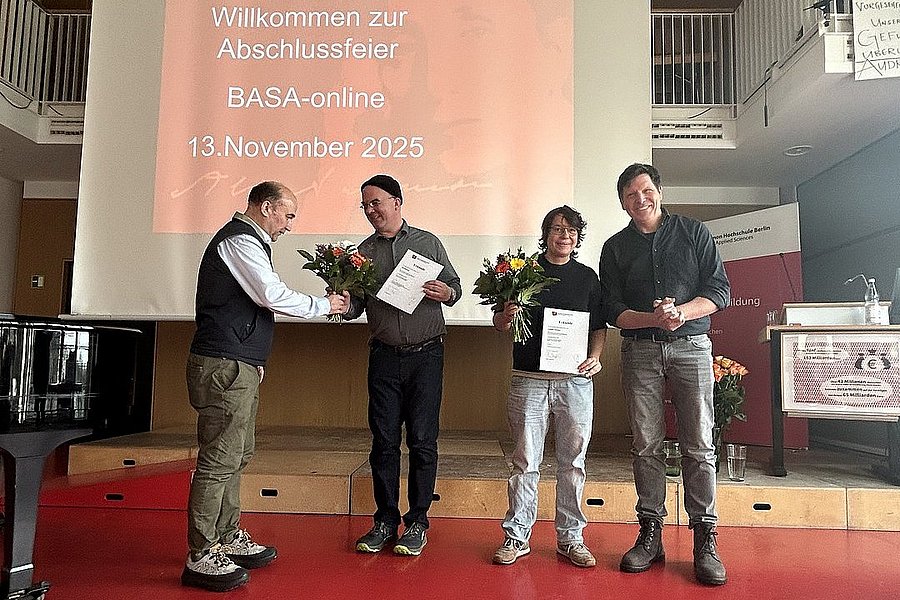
On November 13, 2025, the graduates of the bachelor's degree program BASA-online were bid farewell at ASH Berlin. Two outstanding bachelor's theses, which are characterized by particular innovative strength and scientific relevance, were awarded prizes. Graduate Annika Schauer was honored for her thesis "Violence in the Neighborhood", in which she examines causes, dynamics and social work approaches in the context of neighborhood conflicts. Graduate Joel Roerick was also honored for their Bachelor's thesis "Between crisis and continuity - conceptual considerations on the recovery approach in integration assistance", which opens up new perspectives on the implementation of the recovery approach in social work. The recovery approach understands recovery as an individual process shaped by those affected, which focuses on hope, self-determination, participation and meaning - regardless of diagnosis or limitations. In their inspiring speech entitled "Remembrance, not innovation", Joel Roerick emphasized the importance of historical responsibility for the profession. They posed the provocative question of how social work could have developed if the turning point of 1933 had not occurred, and linked these considerations to the basic ideas of the recovery approach. With Joel Roerick's permission, we are publishing the full speech in the alice online magazine:
I am standing here to accept an innovation award for my work Between Crisis and Continuity — Conceptual Reflections on the Implementation of the Recovery Approach in Integration Assistance.
However, today I want to speak neither about the work itself nor about the innovation potential of recovery, but rather about what German social work could have become had 1933 not intervened — and what the recovery approach has to do with the beginnings of the social work profession in Germany before 1933.
The Recovery Approach
First, a brief word on the recovery approach. Recovery means supporting people after mental health crises in such a way that they can experience hope, self-determination, participation, and meaning again — regardless of diagnosis, chronicity, or limitations. It is a human rights-based approach that is well established in the English-speaking world, not only in practice but as a policy framework for community psychiatry. This is not the case in Germany.
In German, recovery translates as Genesung — convalescence or healing. However, the understanding of recovery within this approach represents a paradigm shift: from a clinical to a personal, participation-oriented understanding of healing.
The traditional understanding — or "clinical recovery" — aims for freedom from symptoms and the restoration of functioning. Professionals determine the course of recovery and decide which criteria must be met for it to be considered complete. A frequently stigmatising diagnosis stands at the centre; treatments are often incomprehensible to those concerned. Moreover, the evidence for many therapies and many psychiatric medications is limited or contested.
The recovery approach counters this with a model of personal recovery: a deeply individual process, shaped by the people concerned themselves. They are experts in their own lives. Professionals and peers accompany them on their journey — simply being there, supporting them in practical matters, or coaching them as equals. People find their own meaning and self-determination. The emphasis is on strengthening resources; the goal: to live as well as possible — despite everything. Its models are transparent and action-oriented. Its effectiveness has been demonstrated by numerous studies.
The German Federal Participation Act (Bundesteilhabegesetz, BTHG) comes close to the recovery approach in its intentions, but in practice it has often failed to sustainably improve the rights of people with disabilities and mental illnesses. The recovery approach could fill this gap — offering a concrete, action-oriented vision of what human rights-based community psychiatry, in the spirit of the BTHG, could look like in practice.
My work examines how we can anchor this approach in integration assistance for people with severe mental illnesses — between crisis and continuity.
The Cultural Question
But at this point I want to broaden the perspective: The recovery approach as a possible foundational model for social work in which we support people to live a life according to their own wishes.
With this broader understanding, I want to pose the cultural question of why the recovery approach receives so little attention in Germany. In doing so, I am also indirectly pursuing the question of why the implementation of the BTHG seems so helpless and hopeless.
My thesis: recovery reactivates repressed roots of the social work profession in Germany. This is also what makes the recovery approach so compelling — it connects back to the early ideals of modern social work. It is therefore remembrance, not innovation: a return to one's forgotten self, not the introduction of something foreign.
(Note: Recovery in the Anglo-American sphere historically stems from entirely different intellectual roots than the early profession of social work in Germany. However, both arrive at essentially the same conclusions in their fundamental features.)
The Paradigm Shift of Early Social Work
Early social work in Germany was characterised by a fundamental paradigm shift — one that is directly comparable to the paradigm shift proposed by the recovery approach.
What did the founders of modern social work find when they brought this new profession into being?
In Christian and bourgeois poor relief, the question was always who deserved help — who was worthy and who was unworthy. With the help came moral judgements about those affected: demands for repentance or norm-compliant behaviour. Control, moral instruction, and discipline — extending to outright humiliation — were commonplace, rarely questioned, and institutionalised in reformatories and asylums.
This tradition persisted into the 20th century, and in part persists to this day: those who conform are considered "stable"; those who contradict are considered "difficult". Helpers demand compliance and gratitude from those who seek help.
In this climate, social work in Germany was founded over 100 years ago, primarily by Jewish women — by Jeanette Schwerin, Alice Salomon, Bertha Pappenheim, Siddy Wronsky, and their fellow activists.
They demanded a fundamentally different set of values, a fundamentally different way of working than that of Christian and bourgeois poor relief. They demanded practical justice, not charity. Dignity, not a duty of gratitude. Respect for the person affected — as an equal — rather than deference to the helping authority or institution. Their means: relationship-based work, self-determination, help towards self-help, support for participation. And a scientific foundation in which methods of helping are not dictated ideologically or by the subjective discretion of individual helpers, but verified as objectively as possible.
This is strikingly reminiscent of the recovery approach. But the founders of social work did not call it recovery. Instead, they drew their principles from a millennia-old Jewish tradition: Tzedakah.
Tzedakah
Tzedakah is a central Jewish concept. The term is often translated as "charity", but this is misleading. Tzedakah derives from the Hebrew word Tzedek ("justice") and describes the practice of justice.
Unlike charity in the Christian and bourgeois sense, Tzedakah fulfils an ethical and religious-legal obligation. Giving is both an individual and a communal duty, not a matter of choice. Receiving, in turn, is a right, not a mercy. Those in need take what is due to them. The gratitude lies primarily with the givers — grateful to be permitted to fulfil a religious duty. Behind this stands the fundamental assumption that all the wealth of this world has only been entrusted to us to steward during our lifetimes. According to this understanding, those who are destitute enable the wealthy to fulfil their religious duty and, in a sense, to work towards personal and social perfection. Remarkably, the law of Tzedakah also applies to the poorest: everyone gives a certain portion of their income, no matter how small that portion may be. Today, in this context, we speak of Teilhabe — participation — and its counterpart, Teilgabe — contribution: giving is healing. Giving is thus not only a duty but also a right for everyone. It is an honour to give — an act of justice, a normality, free of counter-demands.
Maimonides, the great Jewish scholar of the 12th century, described eight levels of Tzedakah, derived from biblical and Talmudic tradition, which remain valid to this day. The lowest level is giving reluctantly. Dignity-preserving, needs-based, and ideally anonymous help are ranked highly. The highest level of Tzedakah is help towards self-help — support that creates autonomy and independence for those affected.
Maimonides thus captures the essence of Tzedakah well: help that does not shame, provided between equals, carried by joy and appreciation, and aimed at independence. Were he alive today, he would surely be an advocate of the recovery approach or empowerment. And a hundred years ago, he might well have founded the profession of social work alongside Schwerin, Salomon, and all the others.
The Jewish founders decisively shaped the profession of social work through the tradition of Tzedakah — grounded in the fundamental principle of justice rather than charity, in clear contrast to Christian and bourgeois poor relief.
From 1933 to the Present
But then came 1933. Within a few weeks, Jewish and politically active social workers were stripped of their rights. Their voices disappeared. They themselves disappeared. An ethic of justice and human dignity was first banished and later consumed in the flames of the Shoah. The remaining Social workers became accomplices to the cruelties of Nazi policy: the selection of lives deemed unworthy of living and the promotion of a conscienceless and misanthropic worldview.
And the earlier tradition never returned. Despite all attempts at denazification. Despite all attempts to restore human rights and ethics to a place in German culture after the horrors of the Nazi regime. Despite the best intentions of the BTHG.
It is hardly surprising that the BTHG, and with it approaches such as empowerment, inclusion, and recovery, continue to face extreme resistance in this country — contrary to all declarations and self-perceptions to the contrary.
Trust is still regarded as a gamble in many quarters; obedience and subordination remain the norm. Self-determination and participation are all too often mistaken for a loss of control. All too often, people prefer to manage risks rather than build relationships and enable self-fulfilment. The voices that thought differently were silenced in 1933 — and remain silenced to this day.
Therefore
Let us take the gamble of trust.
Let us relinquish some control in favour of self-determination and participation.
Let us embrace the risk of relationships and self-fulfilment.
Let us set out towards a renewed social work: radically egalitarian, radically uncomfortable, radically nonconformist, radically democratic.
This would be social work in the spirit of the recovery approach. Let us remember — recovery brings nothing new:
- Maimonides and the highest level of Tzedakah: enabling independence — a direct parallel to empowerment in the recovery approach.
- Schwerin, Salomon, and their contemporaries conceived of social work as grounded in subjecthood, rights, and participation.
- In the present: recovery reconnects this original ethic with practice.
Perhaps the true innovation lies in remembering the displaced beginnings of social work — its approaches and attitudes that we should never have forgotten.
References
Boecker, M., & Weber, M. (Eds.). (2023). Das Bundesteilhabegesetz (BTHG) und seine Folgen: Personenzentrierung und Wirksamkeitsnachweis als neue Parameter in der Eingliederungshilfe für Menschen mit Behinderungen [The Federal Participation Act (BTHG) and its consequences: Person-centeredness and proof of effectiveness as new parameters in integration assistance for people with disabilities]. Nomos.
Conradi, E. (2018). Forgotten approaches to care: The human being as neighbor in the German-Jewish tradition of the nineteenth century. In J. Boldt, & F. Krause (Eds.), Care in healthcare: Reflections on theory and practice (pp. 13–38). Palgrave Macmillan.
Degethoff de Campos, H. (2018). „Wissen und Wollen!" – Jeanette Schwerin und die Sozialarbeit als Frauenberuf ["Knowledge and will!": Jeanette Schwerin and social work as a women's profession]. Freiburger FrauenStudien, 2, 73–83.
Evers, R. (2025). Zedaka: Der biblische Zehnte [Tzedakah: The biblical tithe]. Hentrich & Hentrich.
Feustel, A. (2014). Alice Salomon (1872–1948): Eine Protagonistin der Moderne und Vordenkerin einer sozialen Gesellschaft [Alice Salomon (1872–1948): A protagonist of modernity and pioneer of a social society]. NDV – Nachrichten des Deutschen Vereins, 84–89.
Ganzfried, S. (1988). Hilchot Tzedakah [Laws of tzedakah]. In Kizzur Shulchan Aruch (pp. 196–204). Goldschmidt. (Original work published 1864)
Heuberger, G. (Ed.). (1992). Zedaka: Jüdische Sozialarbeit durch die Jahrhunderte. 75 Jahre Zentralwohlfahrtsstelle der Juden in Deutschland 1917–1992 [Tzedakah: Jewish social work through the ages. 75 years of the Central Welfare Office of Jews in Germany, 1917–1992]. Jüdisches Museum der Stadt Frankfurt am Main.
Kuhlmann, C. (2012). „Nicht Wohltat, sondern Gerechtigkeit". Alice Salomons Theorie Sozialer Arbeit ["Not benevolence, but justice": Alice Salomon's theory of social work]. Ibidem.
Leamy, M., Bird, V., Boutillier, C. L., Williams, J., & Slade, M. (2011). Conceptual framework for personal recovery in mental health: Systematic review and narrative synthesis. British Journal of Psychiatry, 199(6), 445–452.
Maimonides. (n.d.). Hilchot Matanot Aniyim [Laws of gifts to the poor]. In Mishneh Torah.
Neumann, J. (2011). Tikkun Olam: A concept in need of repair. Degel: Torah and Jewish Thought, 3(2), 32–43.
Neumann, O. (2023). Krisenintervention [Crisis intervention]. In J. Bischkopf, D. Deimel, C. Walther, & R.-B. Zimmermann (Eds.), Soziale Arbeit in der Psychiatrie. Lehrbuch [Social work in psychiatry: Textbook] (pp. 382–402). Psychiatrie Verlag.
Salomon, A. (1926). Soziale Diagnose [Social diagnosis]. Carl Heymanns.
Salomon, A. (2022). Die ethischen Grundlagen und Ziele der Wohlfahrtspflege [The ethical foundations and aims of welfare work]. In Alice Salomon Archiv der Alice Salomon Hochschule Berlin (Ed.), „Über alle Parteiungen weg?" ["Beyond all party divisions?"] (pp. 31–45). Deutscher Verein für öffentliche und private Fürsorge. (Original work published 1921)
Salomon, A., & Wronsky, S. (1921). Leitfaden der Wohlfahrtspflege [Guide to welfare work]. Teubner.
Schmitt, S. (2022). Soziale Arbeit in Krisenzeiten: ein Schlüsseltext von Alice Salomon neu entdeckt [Social work in times of crisis: A key text by Alice Salomon rediscovered]. NDV – Nachrichten des Deutschen Vereins, 4, 174–178.
Slade, M. (2009). Personal recovery and mental illness: A guide for mental health professionals. Cambridge University Press.
Slade, M., & Wallace, G. (2017). Recovery and mental health. In M. Slade, L. Oades, & A. Jarden (Eds.), Wellbeing, recovery and mental health (pp. 24–34). Cambridge University Press.
Stuart, S. R., Tansey, L., & Quayle, E. (2017). What we talk about when we talk about recovery: A systematic review and best-fit framework synthesis of qualitative literature. Journal of Mental Health, 26(3), 291–304.
Telushkin, J. (2006). Tzedaka: The Jewish laws of charity. In A code of Jewish ethics (Vol. 2, pp. 156–259). Bell Tower.
Welti, F. (2019). Zwischen unteilbaren Menschenrechten und gegliedertem Sozialsystem: Behindertenpolitik erster und zweiter Ordnung von 1990 bis 2016 [Between indivisible human rights and a structured social system: Disability policy of the first and second order from 1990 to 2016]. In T. Degener, & M. Miquel (Eds.), Aufbrüche und Barrieren: Behindertenpolitik und Behindertenrecht in Deutschland und Europa seit den 1970er-Jahren [Departures and barriers: Disability policy and disability law in Germany and Europe since the 1970s] (pp. 15–42). Transcript.
Wendt, W. R. (2020). Kurze Geschichte der Sozialen Arbeit [Brief history of social work]. Springer
