

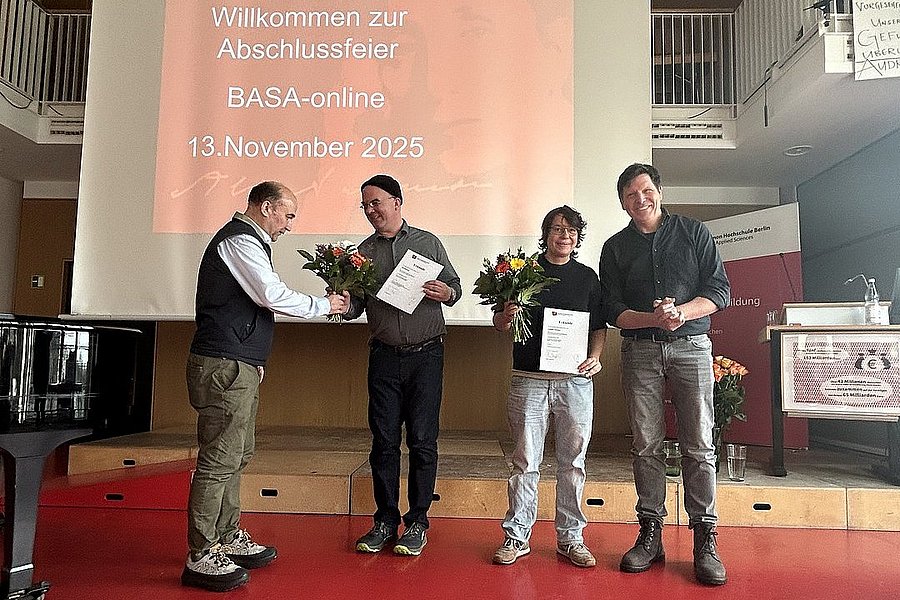
On November 13, 2025, the graduates of the bachelor's degree program BASA-online were bid farewell at ASH Berlin. Two outstanding bachelor's theses, which are characterized by particular innovative strength and scientific relevance, were awarded prizes. Graduate Annika Schauer was honored for her thesis "Violence in the Neighborhood", in which she examines causes, dynamics and social work approaches in the context of neighborhood conflicts. Graduate Joel Roerick was also honored for his Bachelor's thesis "Between crisis and continuity - conceptual considerations on the recovery approach in integration assistance", which opens up new perspectives on the implementation of the recovery approach in social work. The recovery approach understands recovery as an individual process shaped by those affected, which focuses on hope, self-determination, participation and meaning - regardless of diagnosis or limitations. In his inspiring speech entitled "Memory, not innovation", Joel Roerick emphasized the importance of historical responsibility for the profession. He posed the provocative question of how social work could have developed if the turning point of 1933 had not occurred, and linked these considerations to the basic ideas of the recovery approach. With Joel Roerick's permission, we are publishing the full speech in the alice online magazine:
Memory, not innovation
I am here to accept an innovation award for my work "Between crisis and continuity - conceptual considerations on the implementation of the recovery approach in integration assistance".
However, today I don't want to talk about the work itself or about the innovative potential of recovery, but about what social work could have become if 1933 hadn't intervened. And what the recovery approach has to do with the beginnings of the profession of social work before 1933.
The recovery approach
First of all, a brief introduction to the recovery approach. Recovery means supporting people after mental health crises so that they can experience hope, self-determination, participation and meaning again - regardless of diagnosis, chronicity or limitations. It is a human rights-based approach that is established not only in practice but also as a political guideline for community psychiatry, particularly in the English-speaking world. Not so in Germany.
Translated, recovery means recovery. However, the understanding of recovery in the recovery approach represents a paradigm shift from a clinical to an individual, participation-oriented understanding of recovery: the traditional understanding or "clinical recovery" is aimed at freedom from symptoms and the restoration of functioning. Specialists determine the recovery process and decide which criteria must be met for it to be complete. The focus is often on a stigmatizing diagnosis, and treatments are often incomprehensible to those affected. In addition, the evidence for many therapies and psychotropic drugs is limited or controversial.
The recovery approach counters this with a model of individual recovery: a deeply personal process that is shaped by the patients themselves. They are experts in their own cause. Professionals and peers accompany them in their recovery. They are simply there for them, support them in practical matters or coach them as equals. Those affected find their own purpose and self-determination. The key is to strengthen resources, the goal: to live as well as possible - despite everything. Models are comprehensible and action-oriented. Their effectiveness has been scientifically proven by numerous studies.
The Federal Participation Act (BTHG) comes close to the recovery approach in its intentions, but in practice has often failed to sustainably improve the rights of people with disabilities and mental illnesses. The recovery approach could fill the gap in how human rights-based community psychiatry could look in an action-oriented and practical way in line with the intentions of the BTHG.
My work examines how we can anchor this approach in integration assistance for people with severe mental illness - between crisis and continuity.
The cultural question
At this point, however, I take a broader view of the approach: as a possible basic model of social work in which we support people to live a life according to their wishes. With this broad understanding, I would like to ask the cultural question of why the recovery approach receives so little attention in Germany. In doing so, I am also indirectly addressing the question of why the implementation of the BTHG seems so helpless and hopeless.
My thesis: Recovery reactivates repressed roots of the social work profession in Germany. This is also what makes the recovery approach so exciting: it ties in with the early ideals of modern social work. It is therefore a reminder and not an innovation - a return to the forgotten and not the introduction of something foreign.
(Note: Recovery in the Anglo-American world has completely different historical roots in the history of ideas than the early profession of social work in Germany. However, both come to the same basic conclusions).
Paradigm shift in early social work
Early social work in Germany is characterized by a fundamental paradigm shift. This is broadly comparable to the paradigm shift proposed by the recovery approach.
What did the founders of modern social work find when they established this new profession?
In Christian and middle-class care for the poor, the question was asked who deserved help, who was worthy and who was not worthy. With the help came moral judgments about those affected, the demand for repentance and behavior that conformed to standards. Control, education and discipline, including humiliation, were commonplace, rarely questioned and institutionalized in reformatories and asylums. This tradition continued into the 20th century, and to some extent even today: those who conformed were considered "stable". Those who disagree are considered "difficult". The helpers demand compliance and gratitude from those seeking help.
It was in this climate that social work in Germany was founded over 100 years ago, primarily by Jewish women - Jeanette Schwerin, Alice Salomon, Bertha Pappenheim, Siddy Wronsky and their fellow campaigners. They called for a fundamentally different value system, a fundamentally different way of working than in Christian and middle-class care for the poor: they demanded practical justice, not charity, dignity instead of the duty of gratitude. They demanded respect for the person concerned, at eye level, and not for the helping authority or the organization. The means to an end: relationship work, self-determination, help for self-help, support for participation. And a scientific foundation, in which methods of helping are not ideologically or subjectively determined by the helpers, but are examined as objectively as possible. This is very reminiscent of the recovery approach. However, the founders of social work did not call it recovery, but drew their content from a Jewish tradition that is thousands of years old, the Zedaka.
Zedaka
Zedaka is a central Jewish concept. The term is often translated as "charity". But this is misleading. Zedaka comes from the Hebrew term zedek ("justice") and describes the "exercise of justice".
Unlike charity in the Christian and civic understanding, zedaka fulfills an ethical and religious duty. Giving is an individual and communal duty, not a choice. Taking, on the other hand, is a right, not a mercy. Those in need take what is due to them. The gratitude is first of all on the part of the giver: grateful to be able to fulfill a religious duty. Behind this is the basic assumption that all the wealth of this world has only been given to us to manage in our lifetimes. According to this understanding, destitute people enable the rich to fulfill their religious duty and thus work towards personal and social perfection, so to speak. Interestingly, the law of zedaka also applies to the poorest: everyone gives a certain proportion of their income, however small this proportion may be. Today, we speak of "sharing" in this context as opposed to mere participation: Giving is wholesome. Giving is therefore not only a duty, but also a right for everyone. It is an honor to be allowed to give, an act of justice, a normality without counterclaims.
Maimonides, the great Jewish scholar of the 12th century, described eight levels of zedaka, which are derived from the biblical and Talmudic tradition and are still valid today: The lowest level is grudging giving. Dignity-protecting, needs-based and ideally anonymous help is highly valued. The highest level of zedaka is helping people to help themselves - support that creates autonomy and independence for those affected. Maimonides thus summarizes the essence of zedaka well: Help that does not shame, at eye level, supported by joy and appreciation and geared towards independence. If he were alive today, he would certainly be an advocate of the recovery approach or empowerment. And a hundred years ago, he might have founded the profession of social work with Schwerin, Salomon and all the others under the same auspices.
The Jewish founders significantly shaped the profession of social work through the tradition of Zedaka - based on the fundamental principle of justice instead of charity, in clear contrast to Christian and bourgeois care for the poor.
From 1933 to the present day
But then came 1933: within a few weeks, Jewish and politically committed social workers were disenfranchised. Their voice disappeared. They themselves disappeared. An ethic of justice and human dignity was first banned and later burned in the flames of the Shoah. The remaining social workers became accomplices to the cruel Nazi policy: the selection of unworthy lives and the promotion of an unscrupulous and inhumane world view. The former tradition never returned. Despite all attempts at denazification. Despite all attempts to restore human rights and ethics to German culture after the horrors of the Nazi regime. Despite the best intentions of the BTHG. It is not surprising that the BTHG and with it approaches such as empowerment, inclusion and recovery continue to have extreme difficulties in this country - despite all claims and self-perceptions to the contrary. Trust is still considered a risk in many areas, while obedience and subordination are considered the norm. Self-determination and co-determination are all too often confused with loss of control. All too often, people prefer to manage risks rather than shape relationships and enable self-realization. The voices that thought differently were silenced in 1933 - and still are today.
Therefore:
Let's take the risk of trust.
Let's lose some control in favour of self-determination and co-determination.
Let's take the risk of relationships and self-realization.
Let's embark on a new social work: radically at eye level, radically uncomfortable, radically headstrong, radically democratic.
This would be social work in the sense of the recovery approach. Let's remember - recovery brings nothing new:
- Maimonides and the highest level of zedakah: empowerment as a direct parallel to empowerment in the recovery approach.
- Schwerin/Salomon etc. thought of social work as subject status, rights and participation.
- In the present: recovery reconnects this original ethic to practice.
Perhaps the real innovation lies in reminding us of the displaced beginnings of social work - its approaches and attitudes that we should never have forgotten.
Selected sources
- Boecker, M. & Weber, M. (eds.). (2023). The Federal Participation Act (BTHG) and its consequences: Person-centeredness and proof of effectiveness as new parameters in integration assistance for people with disabilities. Nomos.
- Conradi, E. (2018). Forgotten Approaches to Care: The Human Being as Neighbor in the German-Jewish Tradition of the Nineteenth Century. In J. Boldt & F. Krause (Eds.), Care in Healthcare, Reflections on Theory and Practice (pp. 13-38). Palgrave Macmillan.
- Degethoff de Campos, H. (2018). "Knowing and wanting!" - Jeanette Schwerin and social work as a women's profession. Freiburg women's studies, 2, 73-83. Beginnings of the Evers, R. (2025). Zedaka: The biblical tithe. Hentrich and Hentrich.
- Feustel, A. (2014). Alice Salomon (1872-1948): A protagonist of modernity and mastermind of a social society. NDV - News of the German Association, 84-89.
- Ganzfried, S. (1864/1988). Hilchot Zedaka [Hebrew]. The regulations for charity. In Kizzur Shulchan Aruch (pp. 196-204). Goldschmidt.
- Heuberger, G. (ed.). (1992). Zedaka: Jewish social work through the ages . 75 years of the Central Welfare Office of Jews in Germany 1917 - 1992 . Jewish Museum of the City of Frankfurt am Main.
- Kuhlmann, C. (2012). "Not Benevolence, but Justice": Alice Salomon's Theory of Social Work. Ibidem.
- Leamy, M., Bird, V., Boutillier, C. L., Williams, J.& Slade, M. (2011). Conceptual framework for personal recovery in mental health: systematic review and narrative synthesis. British Journal of Psychiatry, 199 (6), 445-452.
- Maimonides. (n.d.). Hilchot Matanot Aniyim [Hebrew]. In Mishneh Torah.
- Neumann, J. (2011).Tikkun Olam: a concept in need of repair. Degel: Torah and Jewish Thought, 3(2), 32-43.
- Neumann, O. (2023). Crisis intervention. In J. Bischkopf, D. Deimel, C. Walther & R.-B. Zimmermann (Eds.), Social work in psychiatry. Textbook (pp. 382-402). Psychiatrie Verlag.
- Stuart, S. R., Tansey, L. & Quayle, E. (2017). What we talk about when we talk about recovery: a systematic review and best-fit framework synthesis of qualitative literature. Journal of Mental Health, 26(3), 291-304.
- Salomon, A. (1926). Social diagnosis. Carl Heymanns.
- Salomon, A. (1921/2022). The moral foundations and aims of welfare work (pp. 31-45). In Alice Salomon Archiv der Alice Salomon Hochschule Berlin (ed.), "Über alle Parteiungen weg?" German Association for Public and Private Welfare.
- Salomon, A. & Wronsky, S. (1921). Guide to welfare care. Teubner.
- Schmitt, S. (2022). Social work in times of crisis: a key text by Alice Salomon rediscovered. NDV - News of the German Association, 4, 174-178.
- Slade, M. (2009). Personal recovery and mental illness: a guide for mental health professionals. Cambridge University Press.
- Slade, M. & Wallace, G. (2017). Recovery and Mental Health. In M. Slade, L. Oades, & A. Jarden (Eds.), Wellbeing, Recovery and Mental Health (pp. 24-34). Cambridge University Press.
- Telushkin, Joseph. (2006). Tzedaka: The Jewish Laws of Charity. In A code of Jewish ethics (Vol. 2, pp. 156-259). Bell Tower.
- Welti, F. (2019). Between indivisible human rights and a structured social system. Disability policy of the first and second order from 1990 to 2016. In T. Degener & M. Miquel (Eds.), Departures and barriers: Disability policy and disability law in Germany and Europe since the 1970s (pp. 15-42). Transcipt.
- Wendt, W. R. (2020). Brief history of social work. Springer.
