
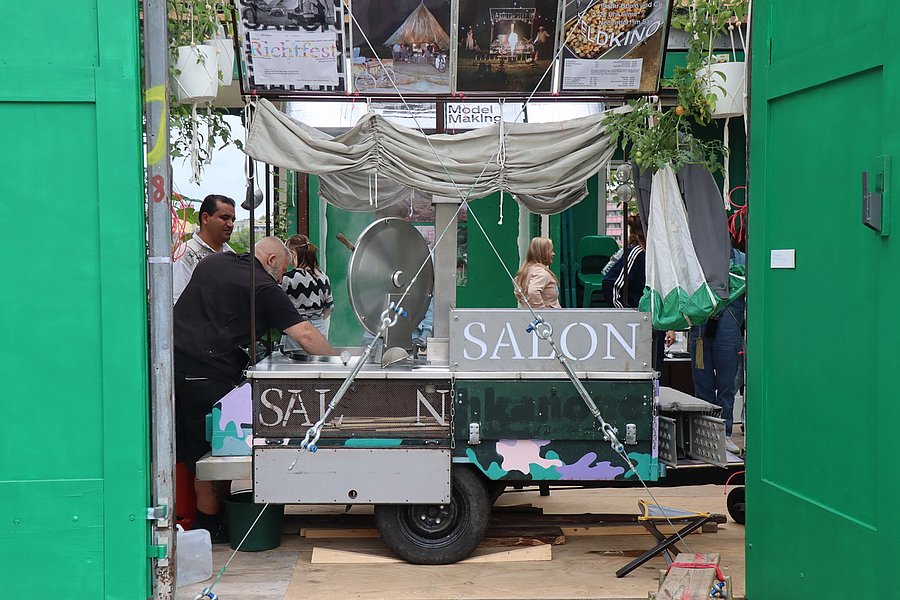
On the last two days of the exhibition at the end of October 2025, I had the opportunity to visit the exhibition pavilion of the neue Gesellschaft für bildende Kunst (nGbK) 'Klassenzimmer der Zukunft' from the ASH project 'Zwischenräume. Revitalizing campus and district' at Alice-Salomon-Platz. Even before I set foot in the place, I was aware that this was not going to be an ordinary art project. I was curious to see how art could function in an urban suburb like Hellersdorf and how it could build a bridge between artistic practice and everyday social life. I was particularly interested in the question of how art can create spaces for encounters, dialog and shared learning - especially in places that are otherwise often overshadowed by city centers.
Description of the project
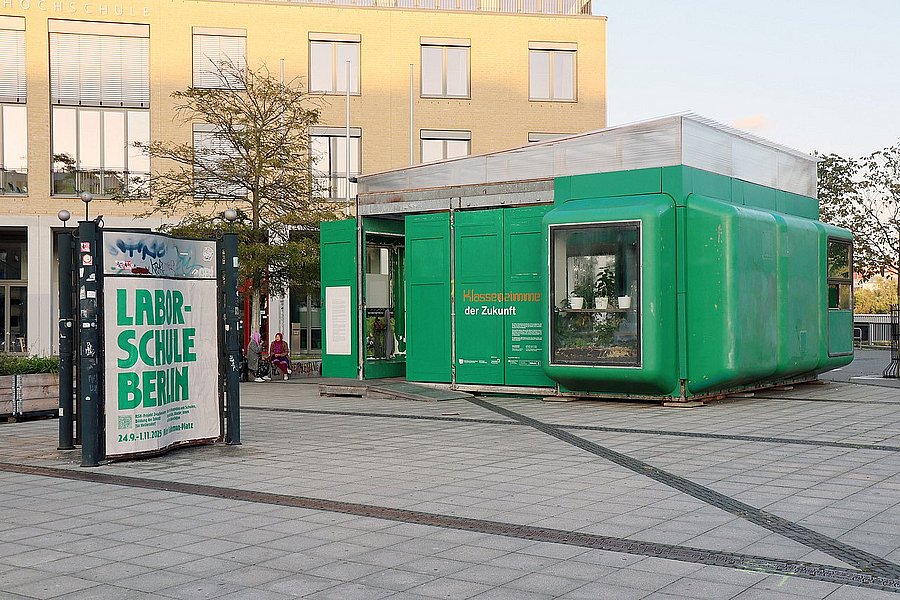
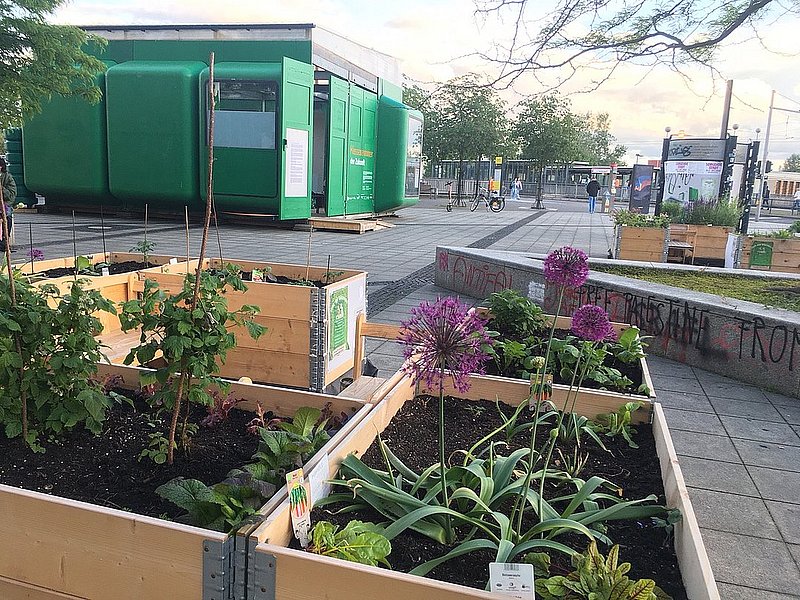
The 'Classroom of the Future' exhibition pavilion is much more than an exhibition space. It is a social and cultural intervention that aims to make the periphery visible as a valuable and active part of the city. The Kunstverein nGbK is lending 'Zwischenräume' a pavilion in 2025/2026, which originally stood as a branch of Dresdner Bank in Frankfurt in the 1970s and was later moved to Hellersdorf as an nGbK location. This architectural and symbolic shift is emblematic of a redistribution of attention and significance.
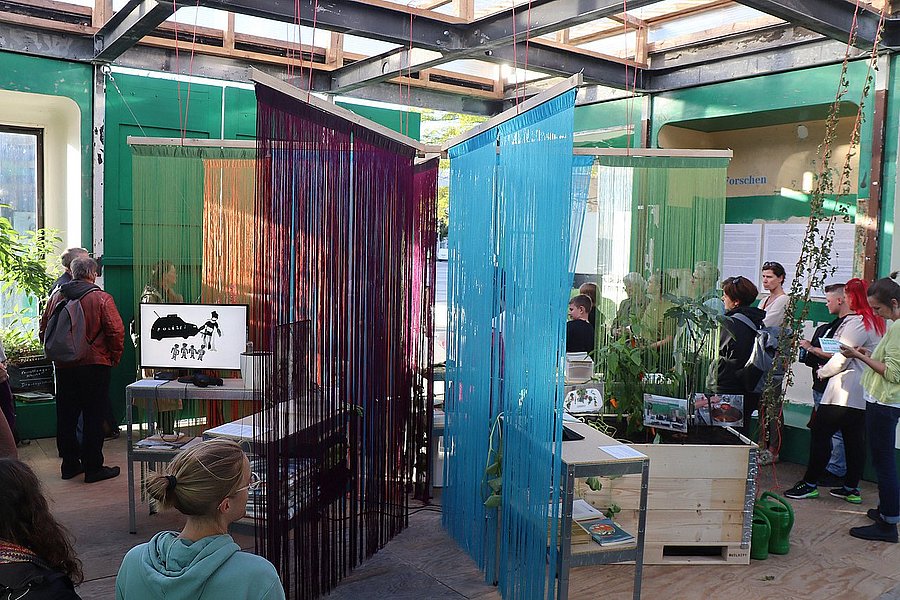
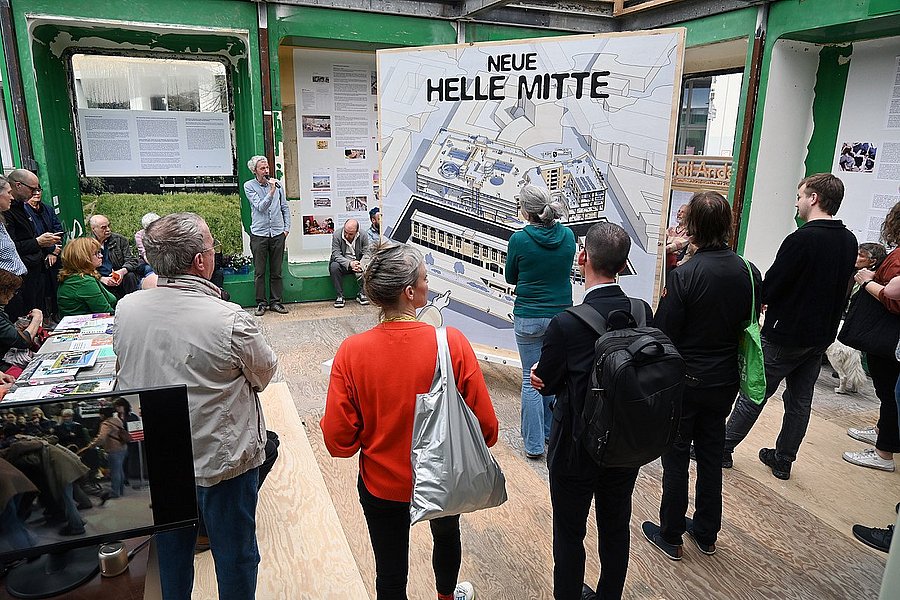
The pavilion's glass façade, which makes the space transparent to the outside, is not only a design element, but also a symbol of openness and inclusion. Exhibitions, discussion evenings, school lessons, seminars, workshops and cultural events are organized in this open space - curated by the academic staff and the artist team Eva Hertzsch and Adam Page. The result is a place where education, art and social interaction come together. Page and Hertzsch see their project as community art, i.e. as an art form that is created in close collaboration with the local community. It is less about the end product and more about the process: about encounters, conversations and creating together.
"Long-term commitment instead of 'festivalizing' the city: they stay, listen and build trust"
Reflection and personal impressions
I was particularly impressed by how seriously the artists take the idea of community and participation. In many projects that I have experienced so far, the claim to participation often remains superficial. Here, however, you can sense that genuine relationships and mutual appreciation are at the heart of the project. The artists are not just on site briefly to "exhibit" something, but stay, listen and build trust. This long-term commitment clearly distinguishes the "Classroom of the Future" from the often-criticized "festivalization" of the city, where cultural events generate attention but leave little lasting impact.
I asked myself what role art plays in a society that is increasingly characterized by social division and economic inequality. The project shows that art can not only be an aesthetic expression, but also a social act. Through the intensive relationship work carried out by Hertzsch and Page, art becomes a tool for recognition, visibility and self-empowerment. I was particularly impressed by the idea of creating a connection between artists and residents through drawings and conversations. It reminds us that every form of artistic engagement is ultimately also communication.
"Every form of artistic exploration is ultimately also communication."
I found it inspiring to see how this space has become a lively meeting place. People from different generations and cultural backgrounds meet here as equals. The pavilion has become a symbol of how important it is to create places, especially in the peripheral districts, that not only facilitate consumption but also encounters.
At the same time, I thought about the challenges associated with such projects. Sustainability is a key issue: how can we ensure that the structures created remain in place when the initial funding ends? This question concerns not only the artists, but also politics and society. I believe that the 'Classroom of the Future' initiates precisely this discussion - about responsibility, continuity and cultural justice
"The future of the city is not created in shining centers, but in the lively encounters of its edges."
Conclusion
The visit to the 'Classroom of the Future' was an enriching experience for me. It showed me that art can have a strong voice not only in the center of the city, but also in the periphery. I understood that true cultural participation requires time, presence and commitment. Adam Page and Eva Hertzsch's project is an example of how art can become an instrument of social change - not through grand gestures, but through persistent work and sincere dedication to the place and the people.
My takeaway from this visit is that the future in the cultural sense begins where people are prepared to take responsibility together. For me, the 'classroom of the future' is a symbol of the fact that learning, art and community are not separate areas, but are mutually dependent. It reminds me that the future of the city is not created in shiny centers, but in the lively encounters of its edges.
Nadia Abid
About the author:
Nadia Abid is a student in the Bachelor of Social Work program at ASH Berlin. Inspired by her participation in a workshop seminar on the topic "This is my place! - Design and appropriation of public spaces" with Elène Misbach, she organized the exhibition 'Laborschule Berlin: Bildung für Zukunft für Hellersdorf. Part 2' in the 'Classroom of the Future'.
She has made her impressions and reflections on this approach to artistic practice, understood as community art in close co-creation with the local community, available online for publication in alice magazine
Funding information / information on the project:
The 'Classroom of the Future' pavilion is part of the 'station urbaner kulturen' / nGbK Hellersdorf' site . The nGbK is making the pavilion available to the Alice Salomon Hochschule Berlin until 2026 as part of the 'Campus Transferale' project funded by the 'Innovative Hochschule' program. The installation of the pavilion is supported by the Marzahn-Hellersdorf district authority.
The project 'Zwischenräume. Revitalization of Campus and District' is a pilot project of the 'Transfer_Hub' as part of 'Campus Transferale' and is scientifically led by Prof. Dr. Andrea Plöger, Professor at ASH Berlin for Social Cultural Work with a focus on media education.