

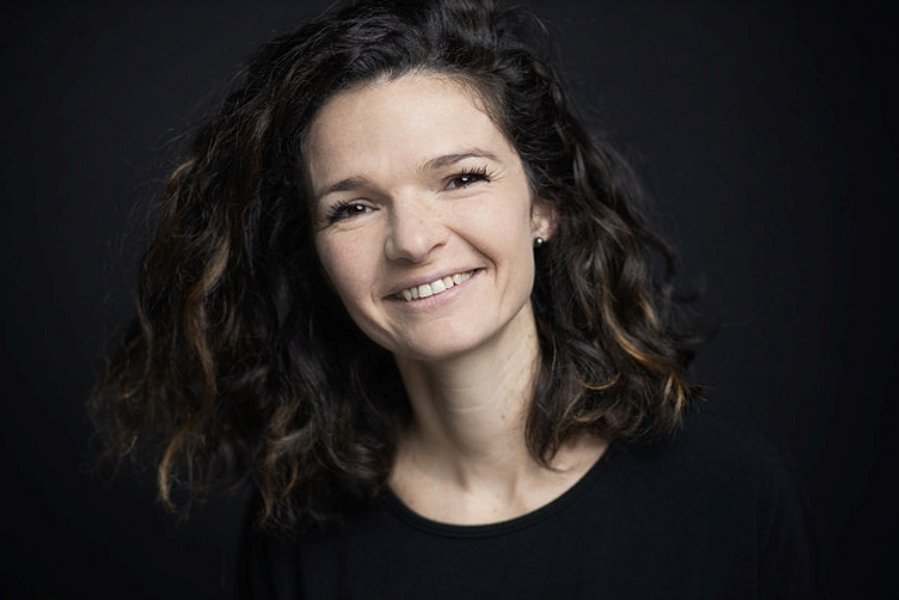
Alumna Lisa Große successfully completed a Bachelor's degree in Social Work at ehs Dresden in 2010 and then worked as a social worker at Diakonisches Werk Stadtmission Dresden e.V. and the Dresden State Health Department before deciding to study for a part-time Master's in Clinical Social Work at HS Coburg and ASH Berlin in 2013.
In this interview, she looks back on various stages of her career path, emphasizes the importance of networking and further training ... and has some valuable advice for students.
Ms. Große, what made you decide to study for a Master's degree?
Lisa Große: I became interested in working with people with mental illnesses, especially severe mental illnesses, relatively early on, namely during my exploratory internship and later also during the practical semester in my Bachelor's degree. The massive challenges often associated with the illness, but also the challenging and crazy behavior touched and still touches me.
When I started as a social worker in the social psychiatric service in 2011, I didn't feel sufficiently trained for this field of work. There were two main reasons for this: The generalized course of study and a hierarchical field of action.
The generalist training as part of the Bachelor of Social Work makes sense in view of the diverse fields of action, target groups and organizations in and with which social workers work. At the same time, I believe that specific knowledge is also required, especially for very complex and specific problem situations.
Who are you thinking of here?
The people I worked with primarily had a mental illness and a variety of problems: they were involved in social-legal conflicts and had difficulties with human relationships. Loneliness was often the result. I didn't feel sufficiently academically prepared to work with these people and I was also sometimes not satisfied with explanations from other professions.
Many social psychiatric services are sensibly multi-professional. This is the only way to do justice to the complex problems of the target group, but also to the requirements of the care landscape (e.g. prescriptions can only be issued by doctors, etc.). At the same time, there is still a hierarchy between the individual professions in many places. Social work is rarely at the top of this hierarchy. Social work should counter this hierarchy with more self-confidence using its knowledge and competence. In doing so, it "helps" itself and its clients by strengthening the profession and acting as an advocate for the needs of clients.
The Master's enabled me to become aware of the sound theoretical and (albeit still expandable) empirical basis of social work. This has significantly strengthened my self-awareness (in the sense of awareness as a social worker) and thus also my professional identity.
Studying part-time certainly presents students with special challenges. How did you cope with this and what strategies did you use to successfully complete it?
First of all, the opportunities that studying part-time brings: I was able to relate the content of the course to the practice relevant to me at all times and at the same time "try out" the theories and methods in practice.
However, this close interlinking of theory and practice also brings challenges: attendance appointments during the course (approximately once a month for three days and one block week per semester) and exam preparations require time and personal capacity. "Allowing" myself this time was sometimes very challenging when crises arose in the work context.
It was important that I thought about how I would like to study beforehand. I wanted to have enough time available to deal with the content of the course in depth outside of attendance times. I can only do this if I can use the whole day for it. That's why I reduced my working hours to a four-day week right from the start. I also had the privilege of receiving financial and emotional support from my family.
To what extent have the universities supported you in achieving your goals? What helped you and what structures could be designed more innovatively in order to achieve a successful work-study balance?
That's a good question. Looking back, I don't think I asked myself this question during my studies because I had the opportunity to fall back on support in the immediate social sphere. At the same time, I was very encouraged by the regular exchange with my fellow students. On the part of the university, however, I must emphasize the very supportive role of the course coordinator and, first and foremost, the course director Prof. Dr. Silke Gahleitner. We students were taken very seriously and strongly motivated to develop both professionally and personally.
Shortly after completing my Master's degree, I was paved the way for my career in science and teaching
What are you doing at the moment? What professional steps have you taken after studying clinical social work?
I'm currently doing my doctorate - and if things go well, I'll finish it at the end of the year. This is also a step that I would never have taken without the Master's degree and the interest in research and science in social work in general that it awakened. I come from a non-academic household, and the insecurities that came with that were changed by the lecturers and their constant encouragement, so I took the risk, which I am very happy about.
After my Master's degree, I worked for some time in the social psychiatric service and was later able to work for three years as a research assistant at ASH Berlin in the third-party funded project "TraM". In other words, a short time after my Master's degree, my path into academia and teaching was paved. In addition to being "firmly at home" in social psychiatric care, I discovered a new passion - teaching social work students - more or less by chance. I have been teaching at various universities since 2018, currently as a guest lecturer at ASH Berlin alongside my doctorate.
What exactly is clinical social work? Why does it make sense to study clinical social work in depth? For which professional fields is this specialization particularly qualified?
Clinical social work has a claim to treatment in the sense of social therapy (not to be confused with sociotherapy under SGB V). Ultimately, clinical social work as specialized social work focuses on psychosocial interventions: Professional relationship building, social diagnostics, social group work, but also counseling along the lines of the "classic" counseling directions.
Continue listening: Episode 15 of the DGSA podcast is all about clinical social work.
It is important to me that clinical social work is NOT social work in clinics - it can be implemented in all fields of action and actually with almost all clients in which health-related tasks (and health is always considered holistically here!) come into focus: children and young people, older people, adults with addictions, mental illnesses, multiple problems, etc. It is important to focus on people who are not so easy to reach - always for good reason. At the same time, specific approaches are needed to get in contact with them and to maintain this contact.
Would you choose to study social work and clinical social work again and why? Are you satisfied with your professional development so far?
Absolutely!!! I am proud to be a social worker and a clinical social worker. I am pleased with the current development of combining science with practice and I very much hope that I can maintain this link in the future. As a student, I have the opportunity to deepen my knowledge in many areas and can develop the awareness that there is a close interaction between person and environment. This means that there is little point in individualizing problems and blaming those who have the least resources to counter the situation. At the same time, however, it is also about finding out how the person's resources can be developed so that they can (once again) live their lives in a self-determined way and without (much) professional support. This complexity will certainly keep social work relevant and interesting into old age and beyond.
What have you learned from your experiences and what would you like to pass on to future generations of students?
That it is (unfortunately) not enough for me to have a Bachelor's degree, but that I should remain curious and inquisitive. This not only strengthens me personally and professionally, but above all for the sometimes structurally based, challenging practice. Further training makes it possible to keep your mind fresh and to reflect again and again. In recent years, I have realized that complex challenges can only be overcome within a network. Be it through trade unions, professional associations, interest groups, loose connections, close work colleagues, etc.
Therefore: Take every network you hear about during your studies with you and stay in touch. I was "introduced" to many very supportive networks through the Master's in Clinical Social Work and especially by the lecturers. All these encounters have led to my path, which I like very much.
Thank you very much for the interview.
The questions were asked by Kerstin Miersch
Find out more about the Master's in Clinical Social Work at ASH Berlin here.
